Showing posts with label Law. Show all posts

The Biggest Information Integration Mistake

Has this ever happened to you?

You phone the customer service line of a large company (bank, telephone, Google AdWords, etc) and get an automated voicemail system.

This voicemail system then asks you for information "to help you get to the right party". You then dutifully punch in your telephone number, bank account number, or client number, whereupon you are transferred to "the appropriate party".

The "appropriate party" finally answers the phone and then they ask you a question. You know what question they ask, don't you?

They then ask you for the SAME DAMN INFORMATION you just gave them.

Sometimes, they then transfer you to one or more other "appropriate parties", who all, without fail, ALSO ask for the same information.

Why?!!!!

In this day and age of analytics and customer tracking, why do companies consistently drop the ball with one the the most important visitors they can possibly have - the current client who needs help or is unsatisfied?

Although privacy laws make it clear that you should not be handing out your customer information to just anyone, they also acknowledge that you are entitled to (and must) collect, pass on and use the information necessary to complete the transaction requested by the visitor. Otherwise there is no point.

It is the height of rudeness to ask someone to give up some of their privacy to you and then for you to treat that information as unimportant and disposable, in the process inconveniencing them.

It's kind of like asking someone for their business card, looking at it, then throwing it away in front of them. Followed immediately by asking them to give you their phone number again. It's stupid, wasteful, inefficient and rude.

This also applies to online forms - deleting a customers form data and forcing them to start over just because they had one typo is bad usability, bad form, and bad programming.

Rules for collecting personal information:

1. Create and enforce a privacy policy that is designed to both protect your visitors and to allow you to do the job your visitors want you to do, safely and securely.

2. Never collect personal information that you do not need to do the job (any additional information should be anonymous and aggregate), and make sure that it's with permission.

3. After you get permission to collect personal information - use it to help the visitor. That's why they gave it to you in the first place, and is the basis of the permission.

Ian

Nuclear Safety and Leadership

Although not political in nature, this post is being made in response to a current political issue in Canada. I don't want to get into politics in this blog, but sometimes politicians and government give us very good fodder for thoughts on decision making and leadership, which is the real reason for this post.

The upshot of the issue in question was that a quasi-independent commission designed to oversee the nuclear industry in Canada ordered the shutdown of the Chalk River nuclear reactor because a safety upgrade was not made in a timely manner.

Sounds pretty straightforward, right? After all, who wants an unsafe nuclear reactor in their backyard?

Turns out there is something else you need to know, however. This particular safety device is a third level backup system (the first 2 backups have to fail first) in order to prevent the reactor, not from blowing up, but from shutting down.

See, there are basically 2 ways to make a reactors - grossly oversimplifying things, the first way is to create a nuclear meltdown or explosion, then attempt to control that explosion through containment and cooling. This was the Chernobyl method. The problem is, if something goes wrong, the meltdown or explosion happens - oops.

The second method, which Canada uses, continually forces the reaction to take place. If something goes wrong, the reaction stops and the reactor shuts down - basically a dead-mans switch. Naturally, this method is far safer, since your main concern is keeping it going, rather than glowing in the dark.

Here is the second thing you need to know - this particular reactor has a very special job. You know how some reactors can make things like materials for nuclear weapons? Well, reactors can make other stuff, too. This one makes special medical isotopes. These isotopes are used to detect cancer, among other things.

The reason you can use them for this purpose is that they have a very limited shelf-life - they stop being radioactive very quickly, thereby making it relatively safe to inject into people to find problems. Because they decay so fast, you can't store them - they have to be constantly made. This reactor makes almost two-thirds of the entire worlds supply.

Because of how critical it is for this reactor to stay up and running, a third level, earthquake-proof backup was required to be installed. For reasons that are not currently clear, the company running the reactor delayed doing this. As a result, the commission shut the reactor down for not performing up to safety standards, thus causing a worldwide shortage of these medical isotopes.

When told to turn it back on, the President of the Commission, Linda Keen, refused to do so, saying that it's her job to shut down reactors that are not safe. The Canadian Parliament had to pass a law to force it back on, and just yesterday, fired her. There is now a big hue and cry over whether this was the right thing to do, which I won't get into here.

Let's look at this for a moment. I don't care about accusations of political partisanship, or any of that stuff - let's just look at the decision that was made to shut down the reactor, and why.

The reactor was shut down because of a safety issue. What was the safety issue? That unless the backup was in place, the reactor might shut down! So the disaster that these rules were in place to prevent was a reactor shutdown. What was the response to placing the reactor in a state where a disastrous shutdown might happen? To shut down the reactor.

Huh?

The response to the possibility a disaster might happen was to deliberately create the very same disaster! From "might" to "will".

This is what happens when people don't think about the big picture. This is the equivalent of fining someone for being broke, or shooting someone as punishment for wearing a bulletproof vest, because you are worried about them getting shot.

The spirit of the law was to prevent the safety issue of a reactor shut down. The letter of the law said that you should shut down the reactor if there is a safety issue. These goals are contradictory in this case. So, what do you do?

Well, you could play it safe and follow the letter of the law, but that's not leadership. Leadership is looking at what the real goal is and accomplishing it.

Ian

Copyright, Trademarks and Pork Milk?

Reading the comments in Jennifers Lactivist blog about her pork problems is almost painful. Actually, it is painful.

In the old days, no one knew what the law was (so the government actually had to pass a law saying that they were deemed to know). Today, probably due to too much television, it seems that they now think they do, but don't.

Having a legal background, it's a pet peeve of mine to see people make statements that are outrageously false or at best on extremely shaky ground as if it were the absolute truth. You'd never hear a lawyer talk like that. Why? because they know better.

Some Examples (usually from anonymous posters):

...you knowingly and flagrantly infringed upon their copyright and trademark...


...Jen, you did violate trademark law.... Derivative works are *not* protected under the law...Trademark law exists to prevent people from cashing in on other people's work. ..


..You women are acting ignorant. This is just a simple case of copyright infringement. It doesn't matter if you are humorously promoting breast feeding infants, or if you are selling auto parts. I have nothing to do with the pork industry, but I am in advertising...You just can't use that phrase, even if you replace a word, because of U.S. Copyright laws...


There are a few common misconceptions here I'd like to clear up.

The Copyright, Creativity And Hard Work Issue

There is a lot of difference between a copyright and a trademark. One difference is, you can't have a copyright on a short sentence or phrase (like "The Other White Meat") because it's not long enough to have a significant amount of creativity to warrant it.

It doesn't matter if they had a team of professional marketers and spent a 100 million, or someone came up with it for free while half asleep after eating too many donuts during a meeting. It's not long enough to be creative enough to fall under copyright law.

To quote the US Copyright Office (which has jurisdiction):

What's Not Protected?

..

Titles, names, short phrases, and slogans; familiar symbols or designs; mere variations of typographic ornamentation, lettering, or coloring; mere listings of ingredients or contents.

...

So this isn't a copyright issue. That also means it's not a creativity issue. If there was enough creativity to be protected, then copyright would apply.

So pronouncements about "fairness" or "stealing hard work" and so forth are not relevant. A trademark is a trademark, and it doesn't matter if it's creative, boring, free, expensive or any of that stuff. Talking about it just muddies the waters and tells people you don't actually know what you are talking about. Same with talking about derivatives - it applies to copyright, not trademark.

Trademark law does concern itself with fairness, but only related to trade (commerce). You can spend almost no time or effort on a trademark and it's not suddenly "worth less", and if you spend a bunch of money to hire someone to make one for you (or buy it, like these pork.org did), it's not "worth more".

It's a trademark, and it's either valid or not. The amount of work or money you put into it is not an issue. There is an exception to this, related to "world famous brands" which I'll get into later on.

The "You Have to Protect Your Trademark" Issue

This one has more substance to it. The idea behind a trademark is to identify the holder of the trademark clearly. That's pretty much it. All of the other rules revolve around this concept.

Therefore, if someone other than the holder of the mark begins to use it, there may be confusion as to who the source is. Further, if a trademark holder fails to prevent others from using it, they may be deemed to have abandoned the mark.

So it's serious business and you need to protect it. Zipper, yo-yo, aspirin, and escalator all began as trademarks that were deemed abandoned because of a failure to protect the mark. You also have to use it, or it may be deemed to be abandoned.

It's pretty clear that pork.org are using it, since they have an entire website called http://www.theotherwhitemeat.com/ and the registered trademark symbol is all over it. I can't imagine anyone contesting this in good faith. Since they are apparently sending out C&C's to everyone they can find, I'm not about to argue they have abandoned it due to failure to protect it.

There is one other issue with Trademark law that is relatively new to the US (1995), and is the concept of dilution. Up until then, you'd have to show that there was a possibility of consumer confusion in order for trademark law to kick in.

One thing none of the posters quoted above seemed to realize is that trademark is exclusive to a TRADE and a TERRITORY, not a mark. You can have "Fred's Garage" properly and legally trademarked in 2 different States by two different people. It this was about creativity or hard work or whatever, then that could not happen. That's the territory.

Further, until Apple computers decided to get into the music business, they had little to fear from Apple Records, being in 2 very different industries back in the 80's. That's the trade.

Unless the Lactivist went into the pork-promoting business, traditional trademark law would not have been an issue.

But with the concept of dilution, the issue becomes fuzzy again. The idea behind dilution is to protect not only the trade and territory use, but also the distinctiveness of a mark. The idea is that if enough people use marks similar to yours, even through fair use and so forth, that the value of your mark would be diminished, and therefore should be protected. This brings us back to that "hard work and fairness" exception I mentioned earlier.

I won't get into whether I think this is a good idea or not right now, but this is where we are.
  • It's not a copyright issue.
  • It's not a creativity issue.
  • It's not a money or hard work issue.
  • It's not a traditional trademark issue (wrong trade)
But it could be a trademark dilution issue. So let's look at that. In this case, it doesn't matter if there is a geographic overlap or competition, what matters is the value of the mark itself (a departure from previous laws and rulings).
You can fall afoul of this if it can be shown one or more of:
  1. Blurring - the removal of the brands distinctiveness
  2. Tarnishment - use on poor quality products or in a unwholesome or unsavory context.

Any lawyer making a case creates a checklist for what triggers the act and goes through the list, trying to show something for each item on the list, which is probably where the claim, as weak as it is, about the "tarnishment" of their reputation came from.

In order to comply with the First Amendment in the US, there are some exceptions to this. Note that these are NOT DEFENSES - they are EXCEPTIONS. I noted that at least one poster said something to the effect of, "you broke the law, even if you think you have a defence".

The difference between a defence and an exception in this context is that a defence says that you broke the law, but there is a special punishment (which can actually be a lack of punishment).

An exception is an area where the law doesn't apply, period. There is no breaking of the law, and no defence necessary (assuming you can show that the use is excepted).

I know this sounds like almost the same thing, and in practice it pretty much acts like it, but since this whole case is about words and their use, there is little room for sloppy use of them.

So, what are the excepted areas?

First, you need to show that the mark is considered to be "famous" for the dilution concept to apply.

Since very few people outside of the US have heard of it, you could argue that. On the other hand, they sure paid a lot for it, so someone must have thought it was well known enough to be worth millions. I'd lean towards it being famous, myself.

Once you have done that, these are the exceptions:

  1. "fair use" of a mark in the context of comparative commercial advertising or promotion;
  2. non-commercial uses, such as parody, satire and editorial commentary; and
  3. all forms of news reporting and news commentary.

So *I* can use "The Other White Meat" because I'm reporting and commenting. Bully for me!

The National Poultry Association, I suppose, could probably use it to compare whether or not pork really counts as "white" meat compared to chicken.

The Bottom Line

So that leaves the Lactivist, with everything else pared down to this:

Does the shirt/quote in question trigger the dilution act, and if it did, does it fall under a non-commercial use, such as parody or satire?

That's it. That's the issue. All the other copyright, trademark, yadda, yadda means nothing, and it boils down to the following:

  1. Does the use trigger the Federal Trademark Dilution Act of 1995 - ie does it cause blurring or bring disrepute to the brand holder?
  2. If the act is triggered, was this a non-commercial use such as parody or satire?

If it fails either, then there is no issue. If it passes both, then there is a big problem.

One thing blurring things here is the "non-commercial" part of the second part, since the shirts were being sold through CafePress. Does the fact that the funds were donated to charity make it non-commercial, or does the fact that money is changing hands make it commercial? Does the fact that CafePress make money off it matter?

This post is getting long, so I'm going to go look up some more case law and finish this later.

Ian

Pork, Porn and Shirtless Moms

How on earth does an organization promoting something as lascivious-sounding as "pork" (as in porking, getting porked, etc) decide that it would be a good idea to tell a woman to remove her shirt immediately because the promotion of breastfeeding using "the other white milk" was so naughty sounding it might make them look bad?

See, a colleague of mine, Jennifer Laycock, started a website (The Lactivist) a while ago for two reasons: 1) to promote a cause she believes in, breastfeeding, and 2) to demonstrate to new SEO's how to promote a website from start to finish.

Through the use of savvy marketing and very clever marketing and slogans, she did quite well.

Then along came the National Pork Board with a C&D that claimed she was violating their trademark with one of her (very funny) t-shirt slogans: "The Other White Milk".

Ok, I might be able to write this off as institutional auto-pilot (sue everyone and sort it out later), but as part of the C&D the claimed the following:


"In addition, your use of this slogan also tarnishes the good reputation of the
National Pork Board's mark in light of your apparent attempt to promote the use
of breastmilk beyond merely for infant consumption..."

So, apparently, if a breastfeeding site makes any reference to breasts, it's pornographic and likely to "tarnish the good reputation of the National Pork Board's mark".

I guess it's only OK to feed your kid breast milk if your breasts are not involved in the process.

I have a better idea. Maybe it would be better to only feed your kid if pork is not involved. Myself, I'm banning pork from the house for as long as this goes on.

On a related note, let's take a look at pork's reputation, shall we? You can't claim your reputation has been harmed unless your reputation is good enough to be harmed in the first place.

I was recently involved in a case where someone sued a blogger regarding comments, claiming that the comments hurt their reputation. The problem is, they had such a bad reputation to start with it would not have been likely the comments would have had any effect at all!

Let's start with an early example - God prohibiting pork because it's unclean in the Bible. I'm not religious, but I would tend to think that kind of thing is more likely to harm pork's reputation more than a breastfeeding kid, but that's just me.

Maybe they should sue God! Or serve a C&D on current Bible publishers to remove that part. If it works, I'm sure other people have other parts they would like to remove too, because it makes them look bad.

Oh, wait, we are only talking about the trademark "The Other White Meat". I can imagine that they are sensitive about this, since they just bought the rights to it for $60 million and probably want to protect it.

Fine, so they want to protect their investment. The value of the investment is based on it's reputation.

Therefore, they are attacking a breastfeeding site. Ummm....

Thing is, because of this incredibly ham-handed (pun intended) attempt at protecting their reputation by besmirching the reputation of others, they have almost certainly irreparably damaged it. Certainly with me and many others.

Pick a fight between moms trying to promote healthy kids VS a polluting, chemical laced product that constitutes the main ingredient of spam and, well, you get what you deserve, frankly.

Ian

Search Sharks - SEO Law Blog Coming

I had one of those "hey! I got an idea" moments today while cleaning out my RSS feed list. I was adding a bunch of blogs, as well as deleting some and moving them up and down (I use a custom Google homepage for my news/rss) and I noticed a trend in my reading habits.

I talk a lot about the law and how it affects SEO/SEM but not enough to fill a blog. I also noticed that Bill Slawski of SEO By The Sea does, as well.

On a whim, I phoned Bill up and we talked about co-authoring a blog devoted to search and the law.

On the plus side, we both have legal backgrounds but don't practice law, which means that we are unlikely to be biased. We have different personalities and approach SEO law in different ways, which makes for more interesting discussions, and finally, we both tend to hang out in different circles, so we each have different sources of information, as well.

On the negative side, we are both swamped with clients and other commitments and really don't have the time to write yet another blog, which is why neither of us has done anything like this yet - we usually just post within our own blogs or on forums instead.

But we both have time to help collect and (more importantly) edit and analyse legal cases and information in a nice, easy to use, free, centralized location.

After doing some domain name searches and working out an agreement in principle, we settled on Search Sharks (searchsharks.com). The domain was just registered this morning and isn't pointing anywhere yet - so don't bother trying to visit yet ;)

As time permits, over the next while we will be trying to put together the premier site for search legal information and news. We'll let you know when it's ready.

In the meantime, I'd love to hear some feedback on what you'd like to see in the blog. Obviously legal news related to the search engines, and possibly new patents and such.

But what else? Is there an area where you have burning questions you want answered? Specific cases you want followed? Maybe things you don't want us to talk about because you are sick of it? Let us know!

Ian

BTM - Blue Time Media (again)

I normally don't spend much time dealing with comments, but since my response to this one by someone claiming to be from BTM was so long, I felt it would be best if I turned it into a post for better legibility.

Here is the comment in full:

mcanerin networks inc(mcanerin.com) are the idiots since btm are school project and as you stated yourself, your company name was left on those pages to give the material the correct copy right. In the other hand, this so call lawyer that calls himself and his company SEO professionals, achieved ranking to their site by utilizing shady tactics and are only scratching the surface of true search engine optimization. That only a REAL SEO Professional knows this tactics are penalization in the major search engines. Trashing competitors on you own blog is patetic, it only makes you look unprofessional. For one Blue Time Media is and Hispanic Marketing Agency that develops strategic planning and implementation of Marketing and Advertising campaigns. So do your homework before embarrassing yourself putting you comparing to us, you lie to people for living we offer Field Marketing And Event Marketing.If you are as good as you claim, why trash on you own block, that is real stupid. You are using this blog for link building to bring traffic to you site on at same time to trash competitors that aren't really competitors.Good job lawyer, i bet you going to erase me fron this blog. Haha dare to leave it so people can read. HAH you can dish it out but you cant take it. Good luck dear, you seam deam desperate for
biz. You been figting with kids, we very proud you think we are good.

Apparently you are not very good students - You get an F Minus and get sent to stand in the corner with a dunce cap on your heads.

English 101: Let's see, you can't spell and have poor grammar. I'll allow that you may not have English as a first language and will not belabor the point. But it's unprofessional to not use a spellchecker while launching an incoherent diatribe against your victims for daring to stand up for their rights.

Logic 101: you've attributed several actions (including future ones) to me that are not true and without basis - that I would delete your post (it's too funny for that!), that I engage in shady tactics, and that I'm trashing a competitor (I'm trashing a criminal - BTM is not a competitor to me or any other competent SEO or marketer).

Law 101: My name was left to give the correct copyright? Huh? Do you actually believe that? So if I copy a bunch of CD's but also photocopy the label saying who the real artist is - it's OK?
Thanks for admitting you are a thief though - I appreciate that.

SEO 101 - "you lie to people for living" - well, although that may be what YOU think marketing is (and your actions seem to support this) it is not. My job is to provide the best results to the search engines and help them realize that.

BTW, I don't use this blog for link building, or at least, not in a directed manner. If I get links, I obviously don't mind. But not everything I do is about marketing and SEO. Sometimes I just want to talk about something and communicate with friends - you know, like most people with blogs.

"That only a REAL SEO Professional knows this tactics are penalization in the major search engines."

Really? Try to find those pages in MSN or Yahoo right now. Go ahead. I actually never got around to sending the one for Google (since it would cost me a stamp, and I didn't really think you were worth even that), but I think I will, now, just for fun.

Ethics 101: A student fails if they plagiarize. You fail.

Marketing 101: "Trashing competitors on you own blog is patetic, it only makes you look unprofessional."

Trashing people you steal from on THEIR blog (and doing it badly) is what's pathetic and unprofessional. And you did the trashing yourself, to yourself, through your actions and responses.

Let's see, would I hire a company to form a strategy for me if I knew that company didn't have enough talent or creativity to come up with it's own materials? Umm... no.

Would I hire them to do advertising for me if I knew they stole other people's advertising and may put my own company at risk as a result? No.

Would I hire a company that would would defend itself in such an unprofessional and unrepentant manner? No.

See, if you had said "sorry, an intern did it by accident, and we've removed it" I probably would not believe you, but I would have let it go. But to have the gall to defend your lawbreaking in such an illiterate and manifestly obtuse manner would be funny, if it wasn't so pathetic and hopeless.

"we very proud you think we are good"

Oops - wrong again - I don't. If that's your basis for feeling pride, then you must have some severe personal issues.

Good luck with your business. You'll need it. Please convey my sympathies to your clients for working with you.

Ian

Go Daddy!!!

That was fast!

It's been less than 12 hours (I went to sleep and woke up with it fixed - on a Sunday, no less!)

GoDaddy has a reputation in the industry for excellent and professional customer service. They are also one of the few ISP's with a proper and formal DMCA process that is fair to all parties. If you are an ISP (especially one based in the US) you should have some sort of process like this - it helps stop you from being held partially responsible for the stolen information (it's on your servers, after all).

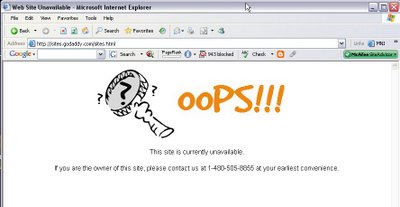
The Blue Time Media website no longer resolves to anything (screenshot below).


I've found that ISP's are often faster to respond to DMCA complaints than search engines, which is why it's part of my DMCA Complaint process. Blue Time Media has the opportunity to respond, of course, though it's really clear that this is not a grey issue (my name is actually on the pages they stole, and every page has a copyright notification on it, so they can't claim independent development, public domain, or anything like that).

I would like to thank GoDaddy for their response, and to take this opportunity to recommend them to my readers. If you are an honest webmaster, they are a great host to have!

Since I offer (limited) hosting myself, I'm technically a competitor, but that doesn't mean I don't appreciate professionalism and service when I see it. This is the second time I've dealt with an issue using GoDaddy. The first was not DMCA related - a client who hosted with them had some problems that were not GoDaddy's fault, but nonetheless the staff there solved for me quickly and efficiently.

Ian

Blue Time Media = Copyright Infringement!

UNBELIEVABLE!

It takes true gall (or true stupidity) to steal copyrighted materials from a lawyer. Especially one with a special interest in copyright law and the Internet.

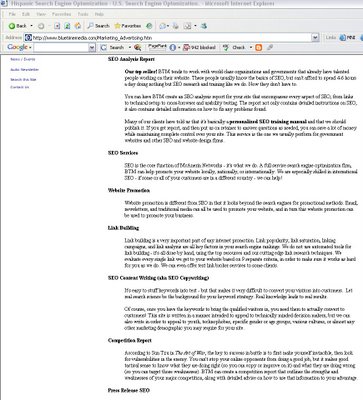
The criminals of the day are Blue Time Media (bluetimemedia.com). I was doing a routine copyright search and found that these thieves had stolen my copyrighted text. Stupidly, they had even posted it and left in my company name by accident at one point! That same page also listed my icons at the bottom, including the "Calgary Chamber of Commerce", "SEO Consultants" and "SMA-NA Board Member" icons, as well as the claim to be AdWords Professionals.

I know I qualify for all those claims, but they certainly don't. I think those organizations should know about those claims, don't you?

The Evidence

http://www.bluetimemedia.com/advertising.htm compare to http://www.mcanerin.com/EN/SEO/


The banner at the bottom they stole is the one I used up until I got my Yahoo Ambassador qualification and updated it, so this was stole sometime in March, which matches the claims they made.

http://www.bluetimemedia.com/Marketing_Advertising.htm compare to http://www.mcanerin.com/.


This really makes me wonder who else's work they have stolen. Are those templates they selling to clients actually theirs to sell? When you start stealing, it's difficult to know where the thief stops.

So, What to Do About Blue Time Media?

Well, getting the word out, and making sure that any current and future potential clients they approach can do due diligence before working with them is a start. If a webmaster puts stolen media or copy on your site, you can be found liable. Personally, I would never work with anyone who I knew was dishonest, particularly over the Internet.

Second, launch Digital Millennium Copyright Act Notifications (DMCA) about Blue Time Media. Here are some sample DMCA templates:

Google DMCA - MS Word Document (32k)
MSN DMCA - MS Word Document (32k)
Yahoo DMCA - MS Word Document (32k)
ISP DMCA - MS Word Document (38k)

Then, of course, contacting their clients and warning them they may have illegal content on their sites placed by their webmaster would seem prudent.

Finally, a lawsuit is in order. I'll have to do that Monday.

Ian

Added: MSN, Yahoo, and GoDaddy all allow emailed notifications, which have been sent. I'll be mailing Google on Monday, along with going ahead with legal action.

Google Confirms Traffic Power Penalty

Finally! Applause goes to Google on this one.

Readers of this blog know that I'm been active, both personally and through my association with the SMA-NA, in trying to help out a blogger who was targetted by Traffic Power due to comments made in his blog.

One of the things TP claimed was that the statements saying that Google had penalized TP were false.

Turns out that TP is the one not telling the truth - Google has officially confirmed that they and the customers they were spamming on behalf of were targetted by Google as spammers.

Nice. Thanks Matt! :)

Note to TP (and the dozen or so new names you are now operating under), if you are going to sue someone (in part) for lying, you might want to make sure that YOU are not the one doing the lying.

Just a thought...

Ian

The Great Internet Trademark Debate

The Great Internet Trademark Debate has been going on for some time, with little indication of an end in sight.

It's complicated by the observation that many people don't see what the big deal is until they have a trademark of their own, at which point they often become rabid about defending it.

I used to do some work for a couple of music companies, and the copyright issue was big then (everyone had pirated MP3's). I often saw musicians with huge collections of MP3's suddenly go onto a "hey! that's MY copyright" frenzy when someone actually uploaded a rip from their album. They were usually pleased at first (for about 15 minutes) and then realized that all the work they had put into the song was now available for free.

There were a few musicians who didn't mind, or who decided that they would upload songs for free, and then make money off concerts, or whatever, but most changed their tune once it actually affected them. From anarchist to capitalist in one rip and upload.

The person who coined the phrase "Imitation is the sincerest form of flattery" obviously didn't have a copyright or trademark on anything...

I'm seeing the same thing in trademarks. Trademarks are a very different area of law than copyright, so you can't apply the same rules, but since they are both about intellectual property, there are some similarities.

Everyone that matters (professional pirates, don't count, IMO) agrees that trademark is intended to protect the public from confusion. Fine. But it often goes further than that. Owners consider often trademark as protection of their business from copycats. Since this is not completely true, there is a lot of confusion about the results and expectations.

Worse, trademark is not a universal thing. If you have a copyright, then you are protected pretty much everywhere in the world (except a few places that are not commercially viable anyway) under the Berne and other conventions. There is no practical geographic restriction, which is good, because the internet has no practical geographic restriction either.

Trademark, on the other hand, is geographically restricted. A trademark can only be enforced in the jurisdiction that it's registered in, and anywhere else that has an agreement with them. Additionally, the geography can be VERY restrictive. Technically, you can have a trademark that is only valid for a few city blocks, under some circumstances. "Bob's Garage" could be trademarked hundreds of thousands of times around the world, and each trademark is exclusive in its area.

This is not compatible with the internet.

Until there is a central trademark system applicable to the internet, we will continue to see issues like this. They will get worse as the internet penetrates more of the world. If eBay does not have a trademark registered in Upper Volta, then they have no basis for any claims related to that country. They would only be effective if the local legal system accepted evidence of "world famous brand" or some such, and that's entirely up to that government.

In practice, since the major search engines are based in the US, right now your best bet is to register your trademark under US law. But that's not going to be a viable option for very long.

Trademark law as it is right now is not compatible with the operation of internet. I'm looking forward to how this is going to turn out. Should be interesting.

Personally, I think preventing bidding on search terms is going too far, but since a French ruling has made it clear that in that jurisdiction it's the law, Yahoo is probably going to follow it. Yahoo and MSN both have far more experience internationally than Google does.

Google tends to be much more US-centric in focus, and although it's working for them right now, I'm not sure that it will continue to do so in the future. At some point, non-US countries are going to get tired of having to deal with the various wierdness of US law.

I predict that if Google goes down, it won't be due to technology or money. It will be due to it's lack of cultural and international awareness and focus, and trademark law will be one of the flashpoints that starts it.

My opinion, of course,

Ian

Blog Comment Legal Issues in the News

There is a new article out by Corilyn Shropshire (Pittsburgh Post-Gazette) inspired by the TP suit against Aaron Wall about the potential legal ramifications of comments in blogs against bloggers.

Since this is very much an interest of mine currently ;) , I'd like to look at the article. For the record, Corilyn did interview me.

The case has raised the ire of bloggers across the Internet, outraged and fearful that companies that don't like what is written about them can sue.

"This kind of thing raises my dander," said Ian McAnerin, a consultant and blogger who founded a search engine industry group, Search Marketing Association of North America. "The speed at which blogs are updated and comments can be made on them makes it very difficult to have editorial control," he added.

Mr. McAnerin said he expects more lawsuits like the one against Mr. Wall as the Internet and blogs become more commercial.

That worries what Mr. McAnerin calls "the little guy," individual bloggers without financial or corporate backing, such as Greg Jarboe. The Acton, Mass.-based blogger runs a search engine-focused marketing firm. "I have a blog, and I call them like I see them," said Mr. Jarboe. "I like to think it's my First Amendment right."


Just to be clear, I never mentioned Greg Jarboe (I didn't even know he had a blog) so although it looks like I used him as an example, I didn't. Nothing personal against Greg, but I prefer to not have words or references put into my mouth. It's possible it's just worded in such a way that I'm not interpreting it properly, but that's how I read it.

I'm still kind of annoyed at him for being the conduit for this drivel:

It is the policy of SEMPO not to comment on any legal cases pending, particularly those that do not directly involve our organization. This matter in particular will be decided under existing case law relating to freedom of speech, libel/slander, and contract law. There is no compelling reason for a nonprofit group with a mission of education and market expansion to become embroiled in a legal discussion unless there is a specific reason for it such as providing expert opinion on definitions or methodologies; and if we had been solicited, then we certainly wouldn’t be able to comment.

I didn't see SEMPO standing up for anyone earlier. So it's not an issue until they come knocking on your own door? Come on. That's just not right.

Having said those nitpicks, it's a pretty good article - too bad TP's lawyer never seems to respond to anything. I suppose it might be a case of "when you find yourself in a hole, stop digging and put down the shovel", but of course I don't know. Maybe it's a master plan or something...

The important part of the article, of course, is this issue:

Will bloggers be treated like newspaper reporters, protected by the First Amendment but subject to libel and defamatory laws, or will they be treated like common carriers," such as telephone companies, and not held liable for what other people write and say? Section 230 of the 1996 Communications Decency Act protects Internet service providers and Web sites from liability for information posted by third parties. But the courts have yet to decide if bloggers enjoy those same privileges. It's his job to convince the court, Mr. Stern said, that bloggers fall in the same category as Internet service providers and Web sites.

Naturally, I'm on the side of blogs being more of a "common carrier" than a "publisher". But it's kind of complicated. See, a blog is a bit of both.

When a blogger writes what they write as an article, they can't turn around and claim they can't be held responsible for their own words just because it's on a blog. Having a blog does not relieve you of taking responsibility for your own actions and words.

Now, of course there are all sorts of defenses such as Freedom of Speech (though that usually only applies to governments), fair comment, personal opinion, fact, discussion of a public figure, and so forth. These obviously apply to all bloggers and, indeed, all writers period - blog or not.

But there are 2 parts to a blog - the original blog entry made by (usually) the owner of the blog, and the comments by others about the entry. These comments are the sticking point, and the area of contention.

It boils down to this:

1. The blogging software company (ie Blogger, in my case) is clearly a common carrier under the law and isn't responsible for what a blogger writes, as they have very little control over it.

2. The blogger is clearly a publisher with regard to their own posts on their own blog. They have total control over what they say and how they say it.

3. The people making comments are a totally different issue. On one hand, you could argue that the blog owner can exert control over their posts. One the other hand, this isn't how it's normally done. - blog spam being a perfect example of the lack of control in this case.

It all boils down to control. Control equals responsibility, most of the time. The more control you have over the results, the more responsible you are for them.

Just because a common carrier *can* exercise control doesn't mean that they do, or should be expected to. If they did, they would probably lose their common carrier status.

So what about bloggers? Should they be expected to exert large levels of control over the comments in their blogs? See, it's not a case of exerting *some* control - it's unavoidable in some cases. But just because a common carrier will often act against an obvious spammer on their network doesn't mean that they are exercising enough control to stop being a common carrier. But it certainly makes it harder to draw the line.

Some have argued that there is a middle position, often called a "distributor". This is the equivalent of a newspaper stand that distributes the newspapers, but has no control over their content. The thinking was that the distributed is not liable unless they know that the publications they are carrying are libelous, at which point they would be required to remove them.

This sounds like it might be the appropriate approach to the comments (it's what TP may consider arguing), but it's not that simple.

First, the courts have held that there is no such thing as a special "distributor liability" - a distributor is just another kind of publisher. However, they have also acknowledged that if you had to check with your lawyer every single time someone complained on the internet about something, you'd go broke - it's just not feasible.

Further, the natural tendency for people in that position would be to simply ban everything, which would result in an unwanted "chilling effect" on speech. Since the reason for this effect would be the response to the law, the First Amendment became involved and things got messy.

"Any attempt to distinguish between 'publisher' liability and notice-based distributor' liability and to argue that Section 230 was only intended to immunize the former would be unavailing. Congress made no distinction between publishers and distributors in providing immunity from liability. As the Fourth Circuit has noted: '[I]f computer service providers were subject to distributor liability, they would face potential liability each time they receive notice of a potentially defamatory statement--from any party, concerning any message,' and such notice-based liability 'would deter service providers from regulating the dissemination of offensive material over their own services' by confronting them with 'ceaseless choices of suppressing controversial speech or sustaining prohibitive liability'--exactly what Congress intended to insulate them from in Section 230. Zeran v. America Online, Inc., 129 F.3d at 333. C.f. Cubby, Inc. v. Compuserve, Inc., 776 F.Supp. 135, 139-40 (S.D.N.Y. 1991) (decided before enactment of Communications Decency Act)."

So, now we are at Section 230 of the 1996 Communications Decency Act. Feel free to read it for yourself. First, the relevant passage is:

Treatment of publisher or speaker. No provider or user of an interactive computer service shall be treated as the publisher or speaker of any information provided by another information content provider.

Sounds great! What exactly does that mean? Well, clearly the lynchpin in the passage is the term "provider" If I'm not responsible because I'm just providing what some other provider created then I'm home free. So we need to know what a provider is in context of this act, and then see how that would apply to a commenter in a blog.

Let's look at the definition of "provider" then:

Information content provider. The term "information content provider" means any person or entity that is responsible, in whole or in part, for the creation or development of information provided through the Internet or any other interactive computer service.

Hmmm... Anyone responsible for the creation or development of information provided through the Internet sounds like "anyone posting their own stuff on the internet". In view of the fact that internet forums were firmly in mind (AOL and Prodigy specifically) when this was passed, I think that's a reasonable interpretation.

The law is also clear that only publishers and speakers are liable - not common carriers, etc. I think everyone can agree that the poster is also the publisher of their own posts.

"User of an interactive computer service" pretty clearly includes website users, I think.

So, to do a cut and replace, that would imply that this passage means:

"No poster or website user shall be liable for information provided by another poster."

I think that pretty clearly spells out the rules for blog comments.

My opinion,

Ian


Traffic Power Lawsuit, Blogging, and the SMA-NA

A lot of people have been wondering about the recent lawsuit against Aaron Wall (seobook) and others by a company called Traffic Power (aka TP, First Place, 1P, etc).

Although I can't answer all the questions, I do have a few thoughts to share. I recently activated comments on my blog (see previous post) and have been doing some thinking as to whether it's a good idea or not, which got me thinking about Aaron's blog and Traffic Power.

The Background:

Traffic Power is an SEO firm based on Las Vegas, Nevada that is pretty infamous in SEO circles. In addition to cold calling and high pressure telemarketing, which annoys people on principle (it's basically "phone spam") they have been shown to practice techniques both directly on their unsuspecting clients websites and also on associated websites intended to funnel traffic and link weight to their clients websites that are considered "high risk" techniques - aka "black hat" or search engine spam.

You'd think that wouldn't be an issue, since many SEO's use similar techniques, and have for years. The problem is, there is currently only one real cardinal sin in the SEO world - getting an uninformed client banned from the search engine you were trying to increase their rankings for.

It's generally considered professional negligence. Kind of like killing your patient or designing a building that collapses under it's own weight. Everyone with even a limited knowledge of SEO knows that doing certain things can/will get you banned or penalized. It's not just expert-level knowledge, it's general knowledge.

Now, sometimes people will deliberately use tactics that are risky and likely to result in a penalty or a ban on websites that they don't care about ("throwaway domains") in exchange for the short term gains that can be made. In these cases, however, the client is fully informed of the risks and the tactics are not practiced on the "real" domain. You basically create sites that are cannon fodder and protect the main site. Even the most notorious SEO spammers are careful about this - you never, ever put your client's flagship site at risk without full client knowledge and consent, particularly if you hold yourself out as a professional SEO offering your services to the public.

Further, you don't spam unless you feel it's absolutely necessary, as opposed to defaulting to it as a matter of course, regardless of the actual competitiveness of the site. Most of us (like me) don't spam at all. Ever.

To make a long story short, apparently Traffic Power acquired a whole bunch of clients by cold calling people with very little clue about SEO, then proceeded to get a whole bunch of them banned from Google due to various known high risk techniques, whether the site "needed" them or not. Google was able to detect this around June 2004 and removed the offending sites from it's database (banned them) en masse.

Naturally, this caused some concern by the people involved. Complaints to TP resulted in emails in return saying everything from "it was a glitch in Googles index" to a much more enlightening quote by a TP business developer (Powers) who was quoted saying to a client that the client failed to understand that getting banned by Google is part of the business. Powers said Google's bylaws are in a constant state of flux because companies like Traffic Power figure out ways to beat them at their own game. Besides, he said Google can't dictate how he operates:

"Google can kiss my ass," Powers said. "This is the wild wild west. As they [Google] get hip to a trick, they change their rule. Google cannot control my business."


While TP was claiming that Google didn't control their business, many of TP's clients were complaining of TP controlling theirs - by getting them banned. TP has the unique distinction of being one of the most complained about companies in the Las Vegas BBB. Currently, the BBB reports that they cannot verify that that TP has a valid business license, and further states that:

This company has failed to eliminate the underlying cause of consumer dissatisfaction.

... then links to Googles webmaster guidelines.

In short, they have a poor reputation with both the SEO community and the Better Business Bureau. Do a quick search on any major search engine for their name and you will see what I mean.

Recently, they have apparently begun to address this by threatening to sue people. I'm not certain how (or if) that is intended to improve their reputation, but I'm also not too sure about their ability to think clearly in the first place, so I can't really comment on it's effectiveness at this time. I do know that some people have removed materials under threats of a lawsuit by TP, so I suppose it works in at least some cases.

In July of this year (2005), Aaron Wall was served with a notice that he was being sued by Traffic Power. He contacted several people, including myself, to get some opinions and thoughts as to what to do next. That's when I got involved.

The Current Situation

I like Aaron personally. And freely admit to holding the same opinion of TP as the rest of the SEO industry. I was more than happy to help him out on a personal basis, but this is a bigger issue. See, Aaron was being sued primarily because of comments made on his blog by other people!

This is a big problem for the SEO community and the blogger community as a whole. See, a blog consists of 2 parts - the "article" part and the "comments" part. Up until recently, I only had the "articles" part of this blog activated, mainly because I hate blog spam and travel a lot, so I was not comfortable letting people post comments on my site without my knowledge and control.

However, the fun (and, some say, purpose) of a blog is to allow people to comment on what you've written. It helps explore issues, provides an opportunity to build a community, and many other, generally positive things. That's why the commenting part of blog software exists and why it's considered different than just a website or a CMS (Content Management System), though you can make it do those things in a pinch.

Every blogger has their own rules for comments. Some don't allow them, some allow a free for all. That's not the norm, though. By not allowing comments, you are missing the point of a blog, and by allowing a free-for-all, you are diluting it's value. Most bloggers are rugged individualists, opinion-wise, and generally excercise very little editorial control over the blog - basically, if it's on topic (Or at least not spam or abusive) at first glance, you let it go without looking at it too closely. Many comments sections in blogs have entire conversations in them that are barely on topic.

In general, the existence of a particular comment in a blog does not mean that the owner exercised editorial control over it being there, it means that it's there because an (often) anonomous person posted it, and there was no pressing and apparent need to remove it for being off-topic. Usually, if you disagree with something someone says in your blog you post a response in your own comments section, rather than remove it or edit it.

In short, the blogger usually acts as a "carrier" rather than a "publisher" or "editor" of blog comments. The normal assumption is that people are responsible for their own comments, not the owner.

The TP suit goes against this idea and basically attempts to treat blogs as newspapers that edit and exercise control over their writers and content. Anyone who has been a victim of blog spam knows that's nonsense.

It would be very bad, IMO, if that interpretation took hold in law. It would be like being at a party, making a comment, then being sued, not for your comment, but for the comments of people in response!

On this basis, I felt it was a key issue, and a serious one affecting the internet as a whole. As such, I discussed it with the other paid members of the SMA-NA at the time and decided it would be best to see what we could do about this on behalf of the SEO and Blogger industry.

It helps that I have a background in law. That's not to say I'm a lawyer (I went into the private sector directly after law school) but I can speak the language and understand the basic principles.

Since the lawsuit was based in Nevada, I talked to Aaron and got his approval to help out on behalf of the SMA-NA. Then I went to one of the best law firms (IMO) in the state - Jones Vargas, whom I've worked with before, and contacted Ariel Stern, an all-around nice guy. Unlike TP's lawyer, who apparently specializes in bankruptcy law, Ariel is an actual litigator.

I told Ariel I was contacting him behalf of the SMA-NA for the purposes of helping Aaron, and educated him on the issues and why we felt that this was a bigger issue than just one blogger. Ariel agreed and accepted a retainer that was about half of the normal estimate under the circumstances. Combined with the people who have been generously donating to Aarons cause, I felt this was a good development.

Next, I contacted Aaron and put the two in touch with each other. Aaron has now retained JV and they have already managed to move the case from state level to federal level, which is a much better position to be in. Naturally, JV's primary duty and goal is to serve the best interests of their client, but is well aware of the bigger picture for bloggers (I pound it home every time I talk to them) and will no doubt keep that in mind while organizing the defense.

The Future

This past week, by coincidence, I was in Las Vegas to give a couple of seminars to a bunch of law firms about SEO for FindLaw, which went well.

As a matter of fact, it went so well that I was able to accomplish two other goals for the SMA-NA (and Aaron).

First, my fellow speaker was the renowned lawyer/blogger Dennis Kennedy, which was a happy coincidence I could hardly allow to pass by :)

When Ariel phoned me later that day (we were going to meet up, but some sudden work got in the way) and started asking me some details about blogs, I realized that I just had an expert on legal issues and blogs sitting next to me!. I've put the two in touch, which will hopefully be helpful. Dennis knows almost all the lawyers who have blogs and is very well known, and I imagine they may have something to say about TP claiming they are liable for comments, etc. ;)

This should be fun. I like fireworks...

The second thing I accomplished was that it was pretty clear that SEO's and bloggers sometimes need legal help (I get questions all the time, for example). So I talked to the fine folks at FindLaw and we are in the process of working out the details on providing methods of connecting experienced internet lawyers to SMA-NA members, in addition to providing other legal resources, advice and benefits.

Once we work out the exact details, I'll use that as a template to approach lawyers in Canada and Mexico so that any SMA-NA member anywhere in North America (or any SMA member worldwide who needs legal help from within North America) will be able get it.

Ian

Trade Mark 46664

I know a lot of patent agents, and even though I'm no longer practicing I still get newsletters, calendars, etc from all over the world. The newsletters help keep me up to date. The following was sent to me by my friends at Adams and Adams, an excellent Intellectual Property Law Firm in South Africa.

The rest of this post is a quote, but for legibility purposes I won't put the quote tag around it - the original authors were the law firm involved and Don MacRobert of Adams and Adams (note: "Madiba" is another name of Nelson Mandela):

A person applied for a trade mark at the Trade Mark Office in Pretoria. The mark consisted only of numbers 46664, which was Nelson Mandelas's cell number whilst in prison. The Nelson Madela family instructed it's legal advisor to object and the following is the Letter of Demand that was sent to the other side:

-------------------------------------------------

Trade Mark 46664
(as said "Four Triple Six Four")

The official records show that you have applied
For trade mark "46664" - so we have spied
Your wide speculation gives us no clues
Whether you will use on hats, clothes or simply just shoes.

We will at this stage refrain to mention
Whether you have the required bona fide intention
Of using the mark for your broad specification
Under the test of reasonable justification.

No - our clients are the Mandela Foundation
You must know them - you agree without hesitation
It goes further than just the client we named
Built on Nelson Mandela - and he's world famed.

Now the numeral which you are trying to claim
Is associated with Madiba - just let me explain
Whether said by word or digit - it matters no more
He's the sole owner of "Four Triple Six Four".

We all know how Madiba was caught
At the treason trial his pleas came to nought
The country was really something to cry for
Our freedom he said he was prepared to die for.

The presiding judge therefore made a finding
Passing sentence which was forever binding
Sent to Robben Island on Cape Town's foreshore
Jailed for life in cell number 46664.

Since his release we were not at all hesitant
To elect him our first democratic President
And for the Nobel there was no hesitation
For that Peace Prize based on his world reputation.

A passing-off action requires us to show
A reputation so wide that all must know
But not his name only - there has to be more
To claim ownership in number 46664.

This we beleive is easy to do
It's known far and wide - not just by a few
Robben Island has of course been proclaimed
A national monument because it's so famed.

Thus - daily there are thousands who flock
To view Robben Island from Cape Towns's dock
They get shown around prison then peep through the door
Into that notorious cell no. 46664.

So "What's in a number" do I hear you say
Well this is so special we claim if we may
A prima facie case, just as in tort
Reducing your version with problems so fraught.

Our instructions are clear and without more ado
There is only one thing that is now left for you
We call on you forthwith to withdraw
Trade mark number 46664.

-------------------------------------------------

Note: the trade mark application has now been withdrawn.

Ian

Forum Owners and the Law

There have been some pretty "authoritative" statements relating to cyber law and Forums that I think are misleading at best and need to be cleared up.

Here are some of the issues:

A common-carrier is not generally liable for statements they are involved in disseminating any more than the phone company would be. This is legislated in the US via the CDA s. 230 and is acknowledged in Canada, UK and Austrailia under common law, at least.

A distributer is also usually not liable. This covers newspaper carriers, news stands, etc.

A publisher/editor very often IS liable. The issue becomes: is a forum a provider, distributer or publisher?

The answer, IMO, is it can be any of them. Let me explain.

If you practice no effective control over the content of your site, then you are generally considered a distributer or common-carrier. If you practice complete control (for example, pre-moderating) then you would be considered a publisher and would typically be liable.
Forums tend to fall in between these two extremes, and therefore blanket statements regarding liability (or lack thereof) are highly misleading.

It's all about control.

Rule of Thumb: If you have control, you have liability. If you don't and can't be reasonably be expected to, then you don't.

This is basic to most legal systems world-wide, not just for libel but for most other torts and a good portion of criminal law. There are some exceptions, but usually only in the case of clear legislation that overrides this principle on purpose, and they are usually only constitutional if the potential negative results of a wrongful application are minor (ie a regulation resulting in a fine, as opposed to a jail sentence). It's strongly related to the principle of mens rea.

Here are some examples of someone saying libelous things about someone else on a forum and the probable result under different circumstances. Lets assume that the statements are libel for now to make things easy. The stated results are the most probably result given current rulings, but should not be considered definitive (anything that isn't a ruling by a supreme court should not be considered definitive).

1. The forum is pretty much an internet newsgroup with anonomous users, absent administrators (or ones that only monitor uptime, rather than content) and no moderators. Result: Forum not liable as common carrier in US, in the UK it's the Internet Defense, or "innocent dissemination".

2. The forum does not pre-moderate, but has a group of moderators and admins reserve the right to edit posts. Result: Forum not Liable in US (Schneider v. Amazon.com, Inc.) I suspect it might be liable in other places, but there is no clear case law yet that I could find. The UK puts the onus on the defendant rather than the plaintiff as in the US, so I suspect they would be liable in the UK. In the UK, you pretty much have to prove complete "innocent disemination" or you fall into the other side of things and are liable

3. The forum requires a login and tracks users, and all posts are pre-moderated or checked by an editor before posting. Result: Forum liable as publisher/editor

4. The forum does not pre-moderate, but has an active group of moderators and admins who routinely remove libelous material and the libelous material "got through". Result: forum liable, but can protect itself by removing libelous material quickly when brought to it's attention In the US, a distributor of defamatory material who is not primarily responsible for the material's content is liable only if that distributor knew or had reason to know of the material's 'defamatory character. Many forums fall under this group.

5. The forum does not pre-moderate, but has an active group of moderators and admins who do not remove libelous material but do actively remove other material.Result: Forum liable since the decision NOT to edit is editorial in nature, rather than oversight or mistake. I believe forums that agressively "out" spammers and assorted alleged scum fall under this category.

6. The forum does not pre-moderate, and has an group of moderators and admins who frequently add or contribute libelous material. Result: Forum liable as publisher as well as author.

In all cases, the original party stating the libel is liable (Tambwo v. Calvin). However, in cases where liability is joint and severable it's usually easiest to go after whoever has the most money or is easiest to find, which is often the Forum, especially when it's hard to track down the original poster.

Ironically, the forum owners biggest asset, it's moderators and administrators, is also it's largest point of potential liability. Although moderators are often not employees, they can be held to be agents, and therefore can result in the liability of their principle. They are acting on behalf of the forum with knowledge and permission of the owner and therefore can cause liability to arise. So you could find yourself in trouble if you (as owner) or a moderator/admin chimed in and added to the libelous thread, since that not only makes them liable individually, but shows an editorial control and decision regarding the original post (the decision not to edit, in this case).

I'm not certain what would happen if a mod/admin told the original poster that their post was a bad idea to post, but chose not to delete or edit it. I think it would have to be dealt with on a case by case basis and would hinge on what was "normal procedure" for the forum in question.

The above doesn't even get into the issues related to the international aspects of the internet. The US rule is that you need to have a firm nexus in order to be sued in a different jurisdiction from the forums "home" ( Stanley Young v. New Haven Advocate, et al.) But an Austrailian ruling about a month ago has challenged that. (Dow Jones). basically if you have a substantial number of subscribers/readers in a country, that's enough to form the nexus for that country, was the ruling.

If a forum has members in China, they can be sued under Chinese law, according to this. Canada is already leaning towards this concept, and I suspect most other countries will, as well. It's unlikely they will simply accept the highly US-centric (and state-specific) rule the US uses. I suspect also that it's a matter of time before the US changes it's mind, as well, if only to allow it's citizens to sue foriegn publications diseminated on the internet. Right now they can't, and I doubt that will last for long.

Naturally, all this assumes that the statements are truly libel. If you "out" a spammer and they really are a spammer, then you have the defense of truth. This isn't the time or place for a discussion on what libel is or isn't, so I'll stop now.

Ian